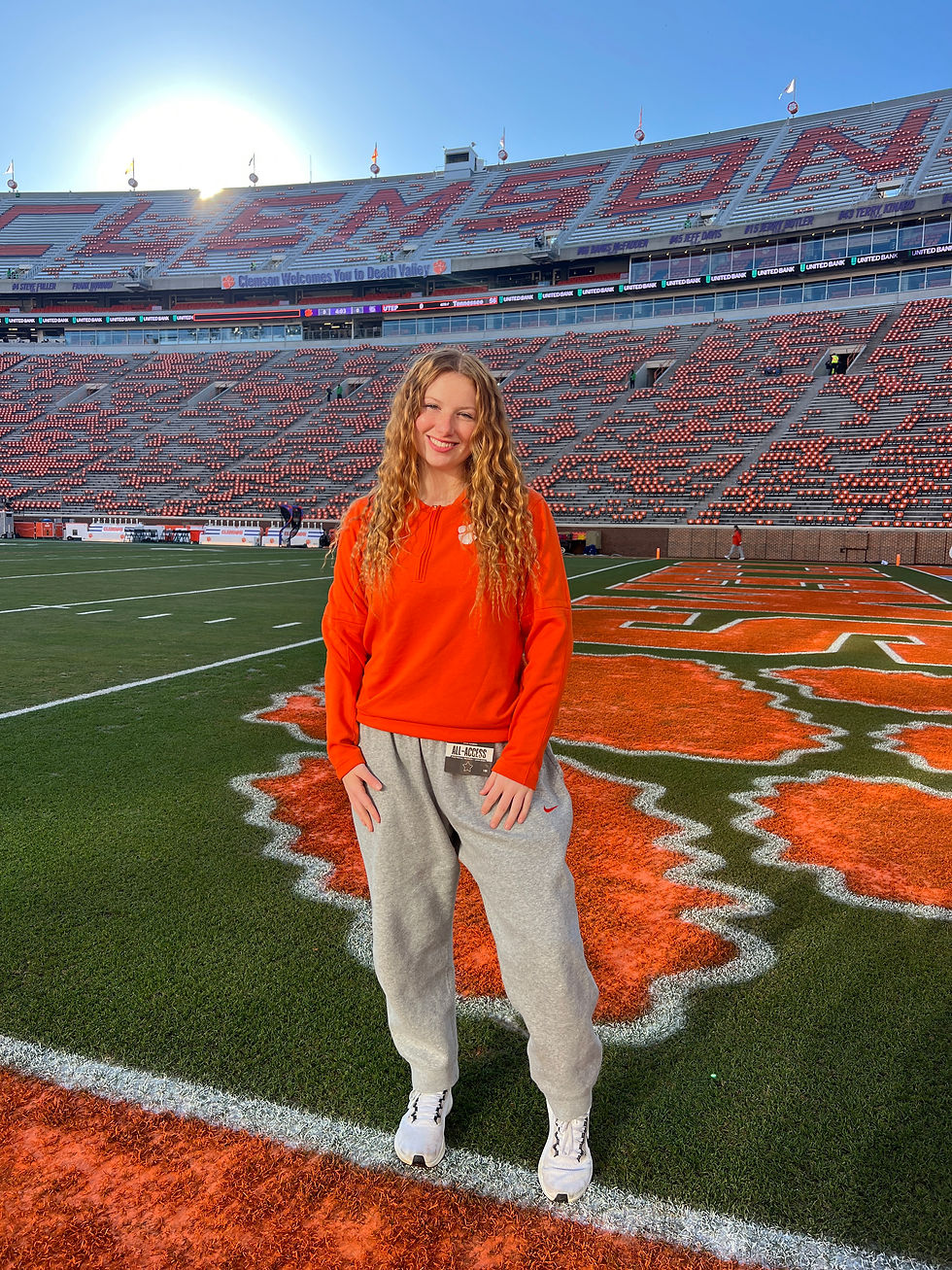
Mickey Grace: UConn Football

Working in football as a woman is a challenge, but breaking ground into coaching can be even more challenging. Being a completely male dominated sport on the field and a majority male dominated sport off the field, it can be a challenge to throw your hat into the ring. Mickey Grace is the Director of Player Development and a Pass Rush Specialist at The University of Connecticut. I had the opportunity to sit down and talk to her about the ins and outs of being a female working directly within the game.

Mickey’s Story:
A little bit about Mickey:
Mickey started her career in football in the Philadelphia area, playing for her local public high school team. From there she continued her college career playing womens rugby. Not enjoying the team atmosphere in college, she played for a year before she began volunteering as a high school football coach, though she doesn’t deem this job “coaching” per say, “I didn't call what I was doing coaching yet. It was just that my high school closed down and all of my school had kind of got put into another school, so I went back just to help out and be you know an alumni on the field. But everybody either had played with me or played against me, so it was perfectly fine, but also it took me three years to call what I was doing coaching. And it took someone else to tell me that I was a line coach. And I was like ‘no I'm not really I'm just an alumni like I played on the team’ you know? And they were like ‘yeah but like you run the drills here and you are the one responsible just group of boys at every practice’ like I was driving 45 minutes every day both ways to attend practices, and I was like ‘oh I guess I am.’”
Mickey thought a lot about how life is linear. She thought about it in terms of school, starting in elementary and working your way through college, and she thought that it was the same way with coaching. She soon realized that this wasn’t the case. “I thought coaching was the same way so as a high school coach the next step would be a college coach, and for young coaches it's getting a Grad Assistant (GA). I spent probably five years essentially wasting my time trying to fight for GA roles in the colleges that surrounded me when in actuality that hadn't been a thing yet, like there was no woman who had been a GA of a college football team yet because also, you're the same age as the players so that's the most women they see is probably but you’re not up in the football spaces, like the players spaces, and so there's a separation there. And so I was wasting my time because I thought that's what I was supposed to do. Then I did an internship for an NFL team and I realized that most of the coaches there, none of them had coached in college. And I was like ‘wait I thought you know you coached high school, you coach college, and then you coached elite.’ Like I thought that the career was as linear as the education aspect of it was, and I realized I made that up right like no one told me that that was not a thing.” From here Mickey kept coaching high school to learn as much as she possibly could, she became the defensive coordinator and then started coaching a professional women's tackle team in Philadelphia. She took some more opportunities and continued to learn through different conventions and experiences before ultimately landing at UConn.
How did you get started in sports at UConn?
Starting in quarantine, Mickey joined Zoom meetings called “Coast to Coast” which were East Coast and West Coast coaches connecting with each other since football was shut down. These meetings were for minority coaches to connect with each other, allowing everyone to chat with each other and carving out a space for themselves. On one of these calls Anthony Lynn, at the time a Head Coach for the Los Angeles Chargers, joined the call, a call that had over 600 people on it. She asked Coach Lynn a question about racial minorities and minorities in general, stumping him. On the call, there were other NFL coaches hiding within everyone, and on that call happened to be a coach for the Los Angeles Rams who reached out to Mickey later that night. He found it interesting that she had been outspoken, asking questions and being curious. She was offered an opportunity to work within scouting at the Rams for a season from this call, later going on to coach at Dartmouth College. After her year at Dartmouth, the Rams contact had reached out to UConn on her behalf, knowing the coach who had just taken the head job there. She had never received a response, but a friend of hers had been offered a job at UConn football. He asked her to help him move from Ohio to Stores, and the help that she had offered is what allowed her the opportunity to get her foot in the door. “It was over Christmas, someone from the administration gave us a tour and showed him his office, unlocked it and gave him his key and no one else was in the building. I was just looking at the offices and the titles and the names, and I had made my way to the head coach's office and he was in there randomly. I just knocked on the door which is unheard of, like my friend was terrified. He's like ‘I've never really met the man, like you're insane.’ I have all my Dartmouth gear on, my Dartmouth coat like it was funny. I was like ‘Coach, I just wanted to meet you since you were in here. I had been texting and emailing and calling you and the Rams coaches had been calling you on my behalf’ and he was like ‘what's your name?’ And I was like ‘Mickey Grace.’ He was like, ‘I thought Mickey was a boy.’And I was like, ‘Yeah most people do. It's served me in that way though.’ It was obviously the first time and he really like gave it another thought, and then he had asked me to evaluate some film with him and obviously you hope it's it's an interview, you hope it's a a test, but you don't really know, but I also hadn't known what was gonna happen, so we were in these rooms and I'm just the volunteer, like I'm just helping, not even a volunteer. I'm less than that. I'm just like a person who's in the hallway. I'm sitting in the boardroom, debating with these coaches and these executives like, ‘I don't see what you see, what I see is…’ and I'm talking about what I see from high school tapes and transfer tapes. We're evaluating films because they're trying to put a team together right now and so we're chatting and you know I have my philosophies and I'm sticking to them regardless of who I disagree with or not. And I thought like well I botched that like I don't agree with this person or that person, and my list was so different from all these people and I didn't realize it then, but he had offered me a job to probably a week later but the only he's like ‘the only job I have is on offense’ and I was like 'well I guess I'll figure out the other side of the ball.' And so that's how it happened, and I started working with the wide receivers and it was very different but a good thing they blocked too because I was able to at least go through blocking techniques with them. I had a great time, you know, learning it, and it was excellent.”
What challenges have you faced as a woman in a male-dominated field, and how have you overcome them?
“I'm not sunshine rainbows. I'm not a soft spoken woman who sits on the sideline, that's just not who I am. I'm really with the biggest, usually the most violent, roughest group in the game, so I have to be ready to have a sharp edge. I think that people want me to be grateful.” Mickey prides herself on authenticity, she's not good at being “political,” something that the football world strives on. “I don't change my views. I stand on what I stand on. That doesn't always serve me but it gives me peace so I'll take it.” Mickey is who she is, and she isn’t going to change herself for other people. “But also for me as a woman, as a feminine woman, too, like to be very clear, that's also a whole other version of minority in this of where I am on the femininity spectrum, is also a chief component of this, because I've always been hyper feminine. My favorite color is pink, I like glitter, my daughter and I have pink footballs that we throw around, like it's just who I have been, and I've never been anything else. And so a lot of times women who aren't hyper feminine are seen as more capable in a hyper masculine world. But I've had coaches tell me things like, ‘if you didn't look how you look, I would have hired you five years ago’ and like, I don't know what that means to me because, you know, I don't see myself as super hyper pretty. Like, I don't do a whole lot. Like I'm not full face makeup on the field. I'm wearing basketball shorts with tights. I don't even just wear tights outside. Like I wear tights with shorts. Like, I'm always super well aware of my body, but the idea is still that, like, I'm still a black woman. I still have curves that other people don't have. I still have genetics that I can do nothing except respond to.’
Mickey also talked about women and the community within football. How it's women supporting women, to come together in this bigger community that is dominated by men. "Like other women want you to do well and they'll congratulate you, but they don't always want you to do better than them, which is a human problem. I guess it's not a woman problem, but a human problem. And so it's also why I've carved out this women's circle in our community where we can secretly encourage each other, secretly give each other's names for jobs, like people have called me for a job that I did not want. And I was like, ‘I don't want that job, but here are women I know who would kill that role. I was the only girl in the city of Philadelphia who played tackle football. The only one. I was the only one who came back to coach. So like, there was no one else to meet. There was no community, there was no team, there was no competition, but also like, I knew growing up how I grew up that just because someone else was doing it, somewhere else didn't make them my competition."
Do you think the representation of women in sports has improved in recent years?
With 100% certainty, Mickey says it has improved. While it may have not been easy, it has come a long way. She says she now notices that women are earning positions that they are qualified for now, something that she didn’t necessarily have the opportunity to do, even while being qualified. Beyond the initial opportunities, Mickey says that sometimes finding the second opportunity is harder than the first, discussing how grateful she is for having opportunities at both Dartmouth and UConn. “Jen King being at three different programs is elite. I want to say she's an assistant running backs coach. She worked at the Panthers with Ron Rivera, and then from the Panthers, when Ron Rivera moved to the Commanders, she moved to the Commanders, and now that Ron Rivera is no longer a head coach, she now works for the Bears. Its just incredible, its progress. Same with Lori Locust who is at the Titans, her first job was at the Buccaneers. So finding those multiple places and programs, that they’re still employed, its elite. But to go into a new team with a new staff really shows who you are as a coach and how people feel about you as a coworker, and that's really really important to a coach's career, especially in my view to a woman in this profession's career.”
What advice would you give to young women who want to pursue a career in sports?
This is a philosophy of Mickeys that has never changed. She says not to wait for permission, don't wait to ask someone if you can help out or volunteer, don’t think that the world isn’t for you because you didn’t get a big shot. “It's almost like finding a spouse, it doesn't matter how many are wrong because you really just need to find the one, but you really just need to find the one. It can be so discouraging when you're looking and willing to learn, and it seems like an easy thing but it might not work out. So be open and be willing, but don't ask permission. Like it might not be football or whatever sport it is. You might not be at an NFL team or a college team. It might be the local team. It might be the local high school. It might be the worst high school, it might be the best high school. Whatever it is, you need to meet people. When they're gonna have a football clinic, go meet them to find opportunities in the offseason, to shake these people's hands, and tell them you exist and what your willingness is to do so that they can remember you. But also don't stop learning, figure out ways to learn. It took me so long to find a teacher and you don't ever just find one, but like there's so many things I wish I knew earlier that we as women don't get because we're not players of this sport to a level of which it can take over your life. Like even coaching women's tackle, those meetings really aren't comparable. And so there's so much missing in our education of football that we have to try and fill the holes regardless of our employment status, regardless of where you work, so don't ask permission, don't wait for help. But also, always be a pro, always be looked at like a pro, always take what you're doing seriously, because it is serious to you whether it's serious to others.”